Inside Apple AirTag: The Complete Technical Deep Dive into How It Really Works
A comprehensive engineering breakdown of Apple AirTag's U1 Ultra Wideband chip, Bluetooth Low Energy, Find My network architecture, cryptographic protocols, limitations, security vulnerabilities and how apple airtag works
Radhe Krishna Singh
Technology Editor
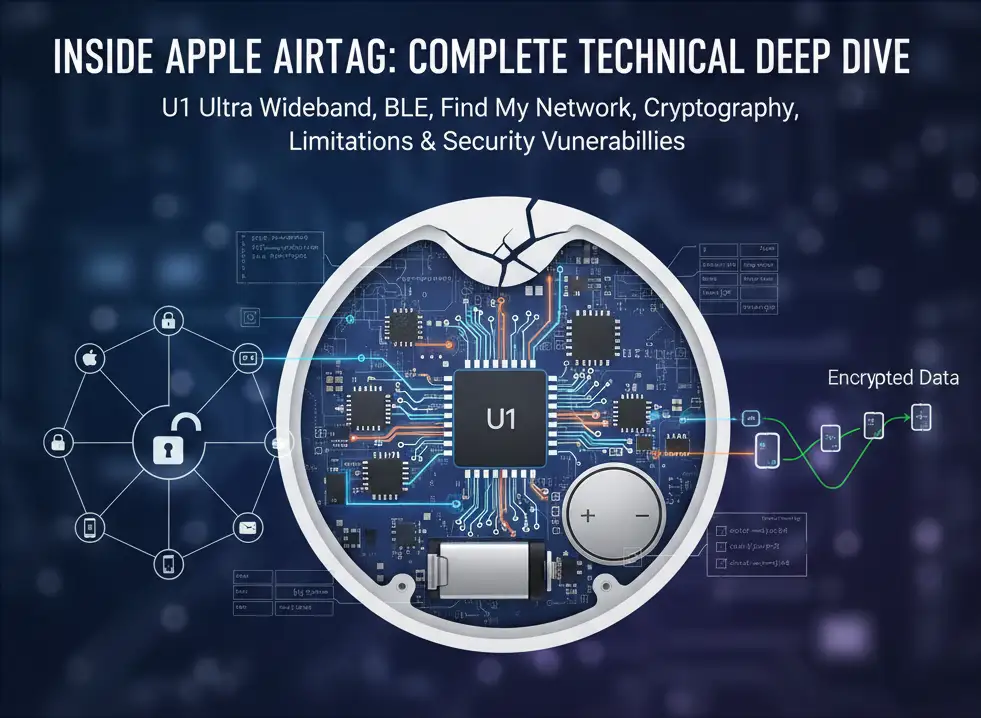
Inside Apple AirTag: The Complete Technical Deep Dive into How It Really Works. A comprehensive engineering breakdown of Apple AirTag’s U1 Ultra Wideband chip, Bluetooth Low Energy, Find My network architecture, cryptographic protocols, limitations, and security vulnerabilities.
Looking for how Apple AirTag works? You’ve come to the right place! This complete guide covers everything from the internal hardware to the cryptographic protocols that power Apple’s tracking technology. Keep reading to discover the fascinating engineering behind this tiny device.
Introduction: More Than Just a Tracking Disc
When Apple launched the AirTag in April 2021, it appeared deceptively simple—a $29 coin-sized disc that helps you find lost items. But beneath that polished stainless steel exterior lies one of the most sophisticated consumer tracking systems ever created.
This isn’t your typical “how to use AirTag” guide. We’re going deep into the silicon, examining every chip, protocol, and cryptographic mechanism that makes AirTag work. By the end, you’ll understand:
- The exact semiconductor architecture inside
- How Ultra Wideband achieves centimeter-level precision
- The mathematics behind Apple’s end-to-end encryption
- Why the Find My network is actually a brilliant crowdsourced mesh
- Every technical limitation and security vulnerability discovered
Let’s disassemble this $29 marvel, piece by piece.
Part 1: The Hardware Architecture
Physical Specifications
Before diving into functionality, let’s establish the physical parameters:
| Specification | Value |
|---|---|
| Diameter | 31.9 mm (1.26 inches) |
| Thickness | 8 mm (0.31 inches) |
| Weight | 11 grams |
| Water Resistance | IP67 (1 meter for 30 minutes) |
| Operating Temperature | -20°C to 60°C |
| Battery | CR2032 lithium coin cell |
| Expected Battery Life | ~1 year |
The Silicon Stack: What’s Actually Inside
An AirTag teardown reveals a surprisingly sophisticated System-in-Package (SiP) design:
1. Apple U1 Ultra Wideband Chip
The Apple U1 is the crown jewel—Apple’s custom-designed Ultra Wideband (UWB) transceiver that enables “Precision Finding.”
Manufacturing Details:
- Fabrication Process: 16nm FinFET by TSMC
- Architecture: Integrated SiP (System-in-Package)
- Components Included:
- UWB transceiver
- Embedded crystal oscillator
- RF switch
- Power management circuitry
Operating Characteristics:
- Frequency Range: 6.5 GHz to 8 GHz (FCC-allocated UWB spectrum: 3.1–10.6 GHz)
- Channel Bandwidth: 500 MHz
- Pulse Duration: <2 nanoseconds
- Pulse Rate: Up to 1 billion pulses per second
2. Nordic nRF52832 SoC
The Nordic Semiconductor nRF52832 handles all Bluetooth Low Energy (BLE) and Near-Field Communication (NFC) operations.
Technical Specifications:
- Processor: ARM Cortex-M4F @ 64 MHz
- Flash Memory: 512 KB
- RAM: 64 KB
- Bluetooth: BLE 5.0 compliant
- NFC: NFC-A tag emulation
- ADC: 12-bit, 8 channels
Power Characteristics:
- Sleep Current: 2.3 µA (theoretical 10+ year standby)
- Active Transmit: ~8 mA during sound playback
- BLE Advertising Current: ~5.5 mA
3. Supporting Components
- Accelerometer: MEMS accelerometer for motion detection
- Speaker: Piezoelectric transducer, rated ~60 dB output
- Antenna Array: Triple-antenna design supporting BLE, UWB, and NFC
- Battery Contact Assembly: Spring-loaded for CR2032 connection
Antenna Engineering
The AirTag’s antenna design is remarkable for such a small form factor:
- Single integrated frame houses three separate antennas
- BLE antenna: Optimized for 2.4 GHz ISM band
- UWB antennas: Dual antennas for directional sensing (Angle of Arrival)
- NFC antenna: Loop antenna integrated into the PCB
The dual UWB antenna configuration is crucial—it enables the receiving iPhone to determine not just distance but also direction to the AirTag.
Part 2: Ultra Wideband (UWB) — The Precision Finding Engine
What is Ultra Wideband?
UWB is a radio technology that uses very short pulses (nanosecond-scale) spread across a wide frequency spectrum (500 MHz+ bandwidth). Unlike traditional narrowband radio (like WiFi or Bluetooth), UWB can achieve extreme precision in timing measurements.
The Physics of Time-of-Flight Ranging
Fundamental Principle: Radio waves travel at the speed of light: 299,792,458 meters per second.
In 1 nanosecond, radio waves travel approximately 30 centimeters.
By measuring the time it takes for a UWB pulse to travel from AirTag → iPhone and back, the system can calculate distance with centimeter-level accuracy.
Mathematical Model:
Distance = (c × Δt) / 2

Where:
  c = Speed of light (299,792,458 m/s)
  Δt = Round-trip time of flight
  Division by 2 = Accounts for round-trip
Example Calculation: If Δt = 10 nanoseconds:
Distance = (299,792,458 × 10 × 10⁻⁹) / 2
Distance = 1.499 meters ≈ 1.5 meters
Two-Way Ranging (TWR) Protocol
AirTag uses Two-Way Ranging rather than simple one-way ToF:
- iPhone sends UWB initiation pulse → Start timer
- AirTag receives pulse, processes, sends response
- iPhone receives response → Stop timer
- Subtract known processing delay → Calculate true propagation time
This eliminates the need for perfect clock synchronization between devices—a critical advantage for battery-operated tags.
Angle of Arrival (AoA) for Directional Finding
The U1 chip in the iPhone uses multiple antennas to measure the phase difference of incoming UWB pulses. This phase difference reveals the angle from which the signal arrived.
The Math:
θ = arcsin((c × Δφ) / (2π × f × d))

Where:
  θ = Angle of arrival
  c = Speed of light
  Δφ = Phase difference between antennas
  f = Carrier frequency
  d = Distance between antennas
Combined with ToF distance, the iPhone now has a complete polar coordinate (distance + angle) to guide you directly to the AirTag.
Precision Finding UX
When activated, Precision Finding provides:
- Visual Arrow: Points directionally toward AirTag
- Distance Indicator: Updates in real-time
- Haptic Feedback: Intensifies as you approach
- Audio Feedback: Optional sound cues
Accuracy: Within 10 centimeters in ideal conditions.
Range: Effective up to ~15-30 feet (varies by environment).
Compatibility: iPhone 11 and later (devices with U1 chip).
Part 3: Bluetooth Low Energy (BLE) — The Long-Range Backbone
How BLE Broadcasting Works
When outside UWB range, AirTag relies entirely on BLE for location tracking:
Advertising Behavior:
- Active (moving): Broadcasts BLE advertisement every 2 seconds
- Stationary: Reduces to every 15 minutes (power saving)
- Accelerometer trigger: Motion resumes 2-second broadcasting
BLE Technical Parameters:
- Frequency: 2.4 GHz ISM band (2402-2480 MHz)
- Channels: 40 channels, 2 MHz spacing
- Advertising Channels: 37, 38, 39 (dedicated)
- Range: ~30 feet indoors, ~100 feet outdoors (open space)
The BLE Advertisement Packet
Each AirTag broadcast contains:
- Rotating Public Key (changes daily)
- Status Flags (battery level, movement state)
- Authentication Data (prevents spoofing)
Critical: The public key is the foundation of Apple’s privacy architecture (detailed in Part 5).
Range Limitations
BLE range is heavily affected by:
| Factor | Impact |
|---|---|
| Walls (drywall) | 20-30% signal reduction |
| Concrete/brick | 50-70% reduction |
| Metal objects | Near-complete blockage |
| Human body | 30-40% absorption |
| Water | Significant attenuation |
Practical Urban Range: In dense environments with many Apple devices, an AirTag’s location typically updates within minutes of being in a new location.
Part 4: The Find My Network — Crowdsourced Location at Scale
Network Architecture Overview
The Find My network is perhaps Apple’s most underappreciated engineering achievement. It transforms over 1 billion active Apple devices into a global mesh network for item tracking.
How It Works:
- Lost AirTag broadcasts rotating public key via BLE
- Any nearby iPhone/iPad/Mac detects the signal
- Finder device encrypts its current GPS coordinates using AirTag’s public key
- Encrypted location uploaded to Apple’s iCloud servers
- Owner’s iPhone downloads and decrypts the location with its private key
The Cryptographic Flow
[AirTag] ──BLE (Public Key)──> [Finder iPhone]
                                     │
                         GPS Location + Timestamp
                                     │
                              Encrypt with Public Key
                                     │
                                     ▼
                            [Apple iCloud Servers]
                                     │
                              (Encrypted blob)
                                     │
                                     ▼
                            [Owner's iPhone]
                                     │
                              Decrypt with Private Key
                                     │
                                     ▼
                            [Display on Find My App]
Key Privacy Guarantees
- Apple cannot read locations: Data is end-to-end encrypted with keys Apple never possesses
- Finders remain anonymous: No identifying information about the finder device is transmitted
- Identifiers rotate: Public keys change daily, preventing long-term tracking by observers
- No location history on AirTag: The device stores no data
Network Density and Coverage
Location Update Speed depends entirely on Apple device density:
| Environment | Typical Update Frequency |
|---|---|
| Major City Center | Updates within 1-5 minutes |
| Suburban Area | Updates within 10-30 minutes |
| Rural Area | Updates may take hours or never occur |
| International Airport | Near real-time updates |
Critical Limitation: In remote areas with no Apple devices, an AirTag is effectively blind—it will only show its last known location.
Part 5: Cryptographic Architecture — The Mathematics of Privacy
Elliptic Curve Cryptography (P-224 ECIES)
Apple’s Find My system uses P-224 Elliptic Curve Integrated Encryption Scheme (ECIES)—a hybrid encryption system combining:
- Elliptic Curve Diffie-Hellman (ECDH): For key agreement
- AES-GCM: For symmetric encryption of location data
Why P-224?
- 224-bit key provides ~112-bit security level
- Smaller than P-256, reducing computational overhead
- Sufficient security for the threat model
- Optimized for mobile/embedded devices
Key Generation and Rotation
During AirTag Setup:
- AirTag generates an initial secret key paired with owner’s Apple ID
- This secret is securely stored on both AirTag and owner’s iPhone
- The secret never leaves these devices
Daily Key Derivation:
Key(day N) = KDF(Key(day N-1))

Where KDF = Key Derivation Function (likely HKDF-SHA256)
This deterministic derivation means:
- Owner’s iPhone can calculate all future keys
- AirTag calculates keys independently but identically
- No communication needed to stay in sync
Location Encryption Process
When a finder device detects an AirTag:
- Extract public key from BLE advertisement
- Generate ephemeral key pair (new for each encryption)
- Perform ECDH between ephemeral private key and AirTag’s public key
- Derive symmetric key from shared secret
- Encrypt GPS coordinates + timestamp with AES-GCM
- Package: Encrypted blob + ephemeral public key → Upload to Apple
Decryption by Owner
- Download encrypted blob + ephemeral public key from iCloud
- Perform ECDH between owner’s private key and ephemeral public key
- Derive same symmetric key (mathematically guaranteed)
- Decrypt with AES-GCM → Retrieve GPS coordinates + timestamp
Security Property: Even if Apple or an attacker intercepts the encrypted blob, they cannot decrypt without the owner’s private key.
Part 6: NFC — The Found Item Protocol
How Lost Mode NFC Works
Every AirTag contains an NFC-A tag that activates when tapped by any NFC-enabled smartphone (iPhone or Android).
Technical Flow:
- NFC field activation powers the NFC circuit (passive, no battery needed)
- AirTag responds with NDEF (NFC Data Exchange Format) record
- Record contains URL:
https://found.apple.com/[unique_identifier] - Smartphone browser opens the URL
- If Lost Mode enabled: Owner’s contact information displayed
NDEF Record Structure:
Type: URI Record
Payload: found.apple.com/[AirTag Serial or Identifier]
Security Consideration
The NFC identifier is static (unlike rotating BLE keys), which creates a potential tracking vector. However:
- NFC range is extremely limited (~4 cm)
- Requires physical, intentional contact
- Limited practical attack surface
Part 7: Technical Limitations — What AirTag Cannot Do
1. No Standalone GPS
Limitation: AirTag has no GPS receiver.
Implication: It cannot determine its own location. All location data comes from nearby Apple devices with GPS.
Impact: In areas without Apple device coverage (remote wilderness, developing regions), AirTag provides zero location updates.
2. No Cellular Connectivity
Limitation: No GSM, LTE, or 5G modem.
Implication: Cannot communicate directly with the internet.
Impact: Entirely dependent on the Find My mesh network.
3. Limited Real-Time Tracking
Limitation: Location updates are opportunistic, not continuous.
Implication: You see the last known position, not a live feed.
Impact: Unsuitable for tracking fast-moving objects or live surveillance.
Update Latency Examples:
- Moving through a city: 1-5 minute updates
- Parked in a suburban lot: 10-30+ minute updates
- Left in a rural area: Hours or never
4. Precision Finding Constraints
| Constraint | Details |
|---|---|
| iPhone Compatibility | iPhone 11+ only |
| Range | ~15-30 feet maximum |
| Environment | Metal and water severely degrade UWB |
| Outdoor Performance | May struggle in direct sunlight (thermal) |
5. Battery Constraints
- Non-rechargeable: CR2032 requires physical replacement
- Lithium coating warning: Some CR2032s with bitter coating may not fit
- Low battery behavior: Reduced BLE advertising frequency, eventual failure
- No low-power mode: Cannot extend life by disabling features
6. Maximum AirTags Per Account
Limit: 32 AirTags per Apple ID
Implication: Not designed for enterprise/fleet tracking at scale.
7. Single-Owner Model
Limitation: Each AirTag is paired to exactly one Apple ID.
Implication: Cannot be shared in real-time with multiple users (e.g., family tracking same item).
Workaround: Family Sharing allows shared Find My access, but pairing remains single-owner.
Part 8: Security Vulnerabilities & Research Findings
1. Lost Mode XSS Vulnerability (2021)
Discoverer: Bobby Rauch (Security Consultant)
Vulnerability: Cross-Site Scripting (XSS) in found.apple.com phone number field.
Attack Vector:
- Attacker puts AirTag in Lost Mode
- Injects malicious JavaScript payload into phone number field
- Good Samaritan scans the AirTag via NFC
- JavaScript executes, redirecting to phishing site or credential harvester
Potential Exploits:
- Fake iCloud login pages
- Session token hijacking
- Clickjacking attacks
- Malware download triggers
Status: Apple was notified but patch timeline was delayed.
2. Firmware Jailbreak & Modification
Researcher: Thomas Roth (stacksmashing)
Method: Voltage glitching / fault injection attack on Nordic nRF52832
Process:
- Voltage glitching bypasses read protection on microcontroller
- Debug port enabled via fault injection
- Firmware dumped using SWD (Serial Wire Debug)
- Modified firmware flashed to another AirTag
Demonstrated Attacks:
- Changed Lost Mode NFC URL to arbitrary malicious site
- Modified BLE behavior
- Potential to alter identifier rotation (evade anti-stalking detection)
Tools Used: Raspberry Pi Pico, custom glitching hardware
3. Anti-Stalking Bypass Techniques
Researchers have identified several weaknesses in Apple’s anti-stalking measures:
Technique 1: Proximity Reset
- Stalker periodically comes within range of their AirTag
- Resets the “separated from owner” timer
- Prevents victim’s iPhone from triggering unwanted tracking alert
Technique 2: Sound Disabling
- Physical modification to remove or muffle speaker
- AirTag still functions but cannot alert victims audibly
- Black market “silent AirTags” have been reported
Technique 3: Android Blind Spot
- Android users receive NO automatic alerts
- Must manually download Apple’s “Tracker Detect” app
- Must manually scan (no background detection)
4. Academic Security Analyses
arXiv Research Papers have examined:
- Signal Spoofing: Broadcasting fake AirTag signals
- Eavesdropping: Passive collection of BLE advertisements
- Jamming: Disrupting UWB/BLE communications
- Location Spoofing: Injecting false GPS coordinates
- Cloud Vulnerabilities: Potential attacks on iCloud infrastructure
Key Finding: The cryptographic core is sound, but implementation details and physical access remain attack surfaces.
Part 9: Anti-Stalking Architecture — Apple’s Countermeasures
iOS Detection System
Alert Triggers:
- Unknown AirTag traveling with iPhone user for 8-24 hours (randomized)
- AirTag moves significantly from original location
- Pattern recognition suggests unwanted tracking
Alert Actions:
- Push notification to potential victim
- Map showing AirTag movement history
- Option to play sound on AirTag
- Instructions to disable (remove battery)
- Option to scan for device (if not found)
- Link to law enforcement resources
Automatic Sound Alerts
Behavior: AirTag separated from owner for 8-24 hours will play audible chime when moved.
Sound Characteristics:
- Volume: ~60 dB (equivalent to normal conversation)
- Pattern: Distinctive chirping sequence
- Duration: Plays periodically until returned to owner or battery dies
Weakness: Sound can be muffled by hiding location, or speaker can be physically disabled.
Partner Industry Initiative
Apple has partnered with Google and other tracker manufacturers on the “Detecting Unwanted Location Trackers” specification.
Goal: Cross-platform detection standard so Android natively detects AirTags (and vice versa).
Law Enforcement Traceability
Key Feature: Every AirTag’s serial number is permanently linked to an Apple ID.
Process:
- Victim provides AirTag to law enforcement
- Law enforcement contacts Apple with proper legal documentation
- Apple provides Apple ID information associated with AirTag
- Investigation proceeds
Limitation: Requires law enforcement cooperation and proper legal process.
Part 10: Comparison with Competing Technologies
AirTag vs. Tile
| Feature | AirTag | Tile Pro |
|---|---|---|
| UWB Precision Finding | ✅ Yes | ❌ No |
| Network Size | 1B+ Apple devices | ~35M Tile users |
| Replaceable Battery | ✅ CR2032 | ✅ CR2032 |
| Anti-Stalking Alerts | ✅ Built-in | ⚠️ Limited |
| Cross-Platform | ❌ iOS only | ✅ iOS + Android |
| Price | $29 | $35 |
AirTag vs. Samsung SmartTag+
| Feature | AirTag | SmartTag+ |
|---|---|---|
| UWB Support | ✅ Yes | ✅ Yes |
| Network | Find My (Apple) | SmartThings Find (Samsung) |
| AR Finding | ✅ Visual arrows | ✅ AR view |
| Ecosystem Lock-in | Apple only | Samsung Galaxy only |
| Price | $29 | $39 |
AirTag vs. Dedicated GPS Trackers
| Feature | AirTag | GPS Tracker (e.g., LandAirSea) |
|---|---|---|
| Real-Time Tracking | ❌ Opportunistic | ✅ Continuous |
| Battery Life | ~1 year | Days to weeks |
| Monthly Fees | ❌ None | ✅ $20-30/month |
| Size | 31.9mm disc | Larger |
| Precision | UWB: centimeters | GPS: 3-10 meters |
| Coverage | Dense urban only | Global (cellular) |
Part 11: Engineering Trade-offs & Design Philosophy
Why No GPS?
Apple’s Reasoning:
- Battery Life: GPS receivers consume 25-50+ mA continuously
- Size: GPS antenna requires significant PCB space
- Cost: GPS modules add $3-10 to BOM
- Monthly Fees: Cellular GPS requires subscription
- The Network Exists: 1B+ Apple devices already have GPS
Trade-off Accepted: Sacrifice real-time tracking for 1-year battery life and $29 price point.
Why Replaceable Battery?
Contrast with AirPods (built-in rechargeable):
- Longevity: CR2032 allows indefinite product lifespan
- Simplicity: No charging cable/dock ecosystem
- User Preference: Many users prefer not to manage another charging device
- Environmental: Debatable—batteries are disposable, but device doesn’t become e-waste when battery degrades
The Precision vs. Coverage Trade-off
UWB Precision Finding:
- Incredible accuracy (<10 cm)
- Only useful in very close range (15-30 feet)
- Requires compatible iPhone
Find My Network:
- Global coverage (where Apple devices exist)
- Accuracy limited by finder device GPS (~3-10 meters)
- Minutes/hours of latency
Apple’s Solution: Combine both—use Find My to get close, Precision Finding for the final meters.
Conclusion: Engineering Marvel with Inherent Constraints
Apple’s AirTag represents a masterclass in constrained engineering:
- U1 chip delivers UWB precision in a consumer device
- Find My network transforms a billion devices into a tracking mesh
- E2E encryption ensures even Apple cannot track users
- Year-long battery from a $2 coin cell
But it’s not magic:
- No GPS = Dependent on Apple device density
- BLE range = 30-100 feet direct
- Updates = Minutes to hours, not seconds
- Security = Vulnerabilities exist; jailbreaking is possible
- Stalking potential = Real concern despite countermeasures
For finding lost keys in a city? Near perfect. For tracking a dog in rural Montana? Completely inadequate.
Understanding these technical realities transforms AirTag from “magic tracking device” into what it actually is: a brilliantly engineered, privacy-respecting, but fundamentally limited crowdsourced proximity beacon.
Frequently Asked Questions (FAQ)
Does AirTag work without WiFi or cellular?
Yes, AirTag itself has no WiFi or cellular. It uses Bluetooth to communicate with nearby Apple devices, which then use their own internet connection.
Can AirTag be tracked anywhere in the world?
Only where Apple devices with Find My enabled are present. Remote areas without Apple devices = no tracking.
How accurate is AirTag location?
- Find My network: 3-10 meter accuracy (depends on finder’s GPS)
- Precision Finding (UWB): <10 centimeter accuracy
Can someone track me with an AirTag without my knowledge?
Possible, but Apple has countermeasures:
- iPhone alerts after 8-24 hours of unknown AirTag traveling with you
- AirTag plays sound after extended separation from owner
- Tracker Detect app available for Android users (manual scan required)
How long does AirTag battery last?
Approximately 1 year under normal use. Heavy use of sound features may reduce this.
Can I use AirTag with Android?
Limited functionality. Android users can:
- Scan AirTags in Lost Mode via NFC
- Use Tracker Detect app to manually scan for nearby AirTags
- Cannot: Use Find My network, Precision Finding, or receive automatic alerts
Is AirTag waterproof?
IP67 rated: Resistant to submersion in 1 meter of water for 30 minutes. Not designed for continuous underwater use.
How many AirTags can I have?
Up to 32 AirTags per Apple ID.
This article represents independent technical analysis based on publicly available information, teardown reports, security research publications, and Apple’s official documentation. AirTag is a trademark of Apple Inc.
About Radhe Krishna Singh
Technology Editor at rakrisi Daily. Covering tech and technology trends.